Overtrading Recovery: Raising the Drawbridge
What Overtrading Recovery Looks Like When the Market Never Closes.
The market is getting ready to stay open almost all night – starting in December this year – pending regulatory approval.
Nasdaq and NYSE Arca are moving toward nearly 23-hour stock trading, five days a week, subject to regulatory approval and implementation. The proposed expansion would give investors access to U.S. equities far beyond traditional market hours.
But I have to wonder: Is more access to the market necessarily a good thing for the trader?
For someone who already struggles to walk away from the screen, who checks charts long after promising to stop, or who believes the next trade might finally make everything right, what happens when the market offers almost no natural stopping point?
Because there’s a difference between having more opportunities to trade and having the emotional capacity to trade them.
And that brings me to an old image from the legends of Camelot that keeps coming back to me.
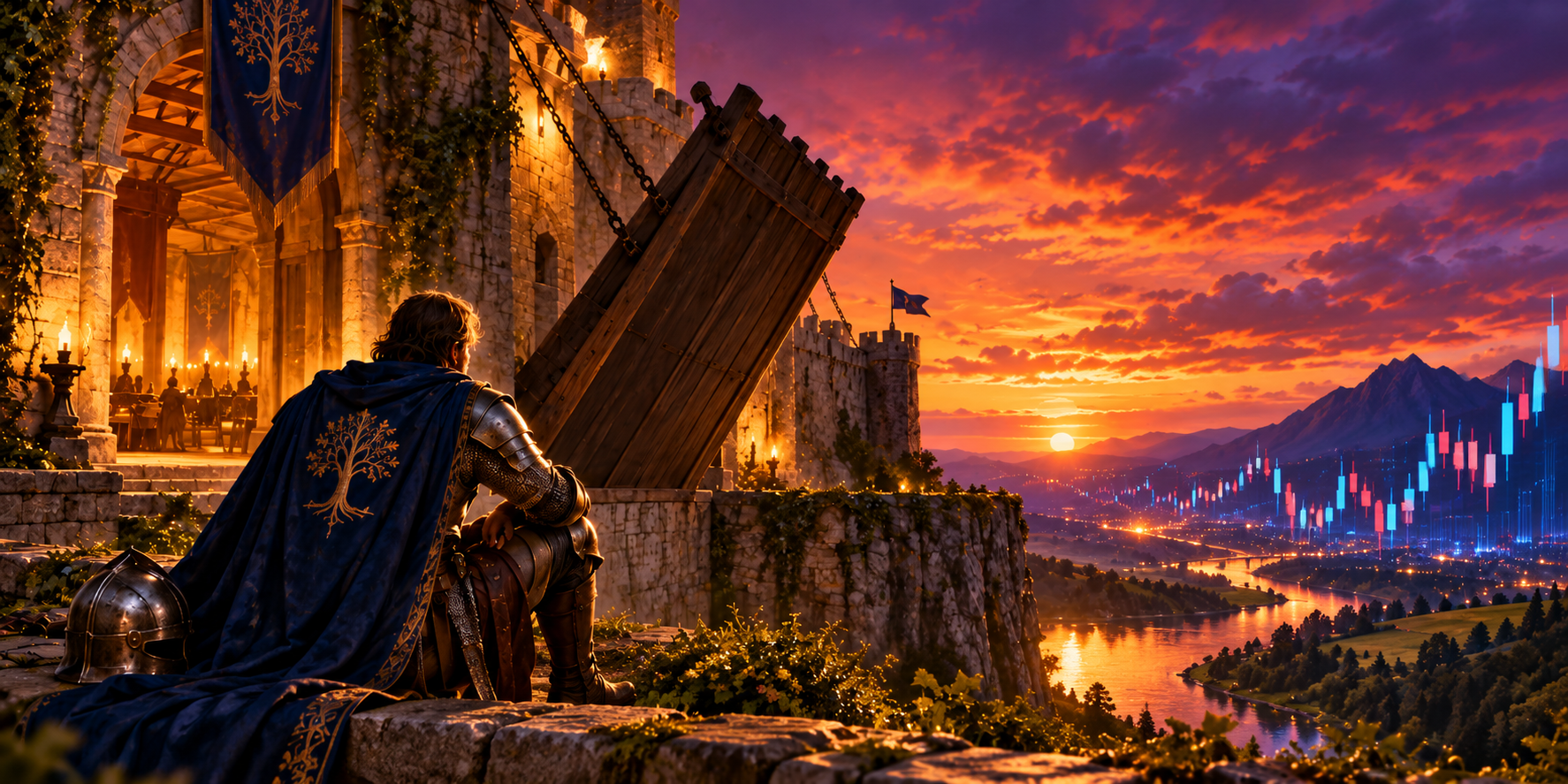
A castle at night. The torches are burning low. The guards are weary. Beyond the walls lies a vast kingdom…
When the market never seems to sleep, who protects the trader?
And at the entrance stands a drawbridge. During the day, the bridge is lowered. Merchants enter. Knights ride out. The kingdom conducts its business. But when darkness falls, the bridge is raised.
Not because the kingdom is afraid of the world. Because even the strongest kingdom needs protection.
I’ve been thinking about that drawbridge as we move further into a world where financial markets are accessible nearly around the clock.
For those of us who trade futures, this isn’t entirely new. The S&P 500 futures market already trades for approximately 23 hours a day during the trading week, with a daily maintenance break.
But extended access to markets, overnight trading opportunities, and the possibility of even more continuous trading raise an important question.
Just because the market is open, does that mean we need to be?
The Kingdom That Never Sleeps
Imagine King Arthur announcing that Camelot’s gates would remain open day and night.
At first, the knights might celebrate. More opportunities for adventure! More battles to win! More chances to prove their courage! But what happens to a knight who never removes his armor?
What happens when every rustle beyond the castle walls sounds like an approaching enemy?
What happens when the sword that once protected him becomes something he cannot put down?For many traders, the market has become that kingdom.
We wake up thinking about our positions. We check futures before breakfast. We watch price action during dinner. We glance at charts before bed.
And sometimes, long after we’ve promised ourselves we’re finished, we return to the screen.
Just to look.
Just to see what happened.
Just in case there’s an opportunity.
And before we know it, we’re trading again.
At Overtraders Anonymous, one of our Characteristics of the Overtrader describes this pattern:
“Returns to the screen after swearing off for the day. Sometimes within minutes.”
Another says:
“Struggles to stop — even when tired, emotionally spent, or past their limit.”
I know those patterns. I’ve lived them. And I’ve learned that the problem isn’t always a lack of discipline. Sometimes, something much older than our trading strategy has taken command.
The Five Knights/Archetypes of the 23-Hour Market:
Carl Jung wrote extensively about archetypes — recurring patterns and symbolic figures that help us understand human experience.
And mythology gives us a beautiful language for recognizing the different parts of ourselves that appear when we trade.
These aren’t clinical categories or diagnoses. They’re mirrors.
When Our Old Wounds Take the Watch
In the legends of Camelot, every knight carried a different story.
Some fought recklessly. Some hesitated when courage was needed. Some broke their oaths. Others became so consumed by the glory of battle that they forgot what they were fighting for. And some were simply afraid.
I’ve come to believe that the trading screen reveals something similar in us.
These aren’t diagnoses or permanent labels. We may recognize ourselves in one, several, or even all five at different moments in our trading lives.
Now, the market didn’t create these wounds. In most of us they happened much earlier in life before we ever became a trader. But it can provide a remarkably powerful place for them to play out.
I created these for Overtraders Anonymous and they’re adapted now into the knights for this article. Perhaps you’ll recognize yourself in them.
1. The Panic Seller — The Frightened Knight Who Retreats Before the Battle Is Over
The wound: “Good things don’t last — so I leave before I can be left.”
Imagine a knight riding into battle with a sound strategy, strong armor, and a clear plan. But the moment the enemy advances, even slightly, he retreats. Not because the battle is lost. Because somewhere deep inside, he believes that danger is always just around the corner.
This is the Panic Seller.
They enter a good trade, but the moment price moves against them, their nervous system sounds the alarm.
They exit too early. Move stops prematurely. Struggle to hold winning positions. Sometimes they feel enormous relief just being out of the trade — even when they take a loss.
For some traders, this pattern echoes earlier experiences in which safety, stability, or good things felt temporary.
What happens in a 23-hour market?
The Panic Seller may find themselves watching overnight price fluctuations, unable to relax because every movement feels like a warning.
They might exit a carefully planned position during a normal pullback, only to watch the market recover while they’re sitting on the sidelines.
And then comes the second wound.
The self-criticism.
Why did I do that again?
Why can’t I just hold a trade?
What’s wrong with me?
But perhaps the more compassionate question is:
What part of me believed I was in danger?
The healing invitation:
You are allowed to stay. Good things are allowed to last.
In recovery, the Panic Seller learns to distinguish between actual market risk and an internal alarm that may be responding to something older.
And sometimes, the most important trade isn’t the one they hold. It’s the moment they learn that they can experience uncertainty without abandoning themselves.
(For a deeper dive into The Panic Seller – watch this video: THE PANIC SELLER)
2. The Revenge Trader — The Wounded Warrior Who Cannot Accept Defeat
The wound: “A loss means I’m not enough — and I have to fix it right now.”
Every kingdom has its warriors. They are courageous, determined, and willing to fight for what matters.
But imagine a knight who has lost a battle and cannot bear to return to Camelot defeated. He turns his horse around. Draws his sword again. And charges back onto the battlefield. Not because the battle is strategically sound. Because the humiliation of losing feels unbearable.
This is the Revenge Trader.
They take a loss and immediately re-enter.
They increase position size.
They abandon their carefully constructed risk limits.
They convince themselves that the next trade will restore what was taken.
But often, they’re fighting something much older than the market.
Shame.
The belief that being wrong means being inadequate.
The fear that failure makes them unworthy.
What happens in a 23-hour market?
The Revenge Trader may no longer have the closing bell to interrupt the cycle.
A loss at 3:00 in the afternoon can become another trade at 6:00. And another at 9:00. And perhaps another after midnight.
Each new session offers the seductive possibility of erasing the previous one.
But the wound cannot be repaired by a winning trade.
Even if the money comes back, the underlying belief may remain.
I am only okay when I’m winning.
The healing invitation:
A loss is not a verdict on your worth. You are allowed to be wrong and still be whole.
The recovering Revenge Trader learns that leaving the battlefield is not cowardice. Sometimes, it is the most courageous decision of the day.
The knight doesn’t need another victory. He needs to remember that he is worthy of returning home, even after defeat.
(For a deeper dive into The Revenge Trader – watch this video: The Revenge Trader)
3. The Freezer — The Hesitant Knight Who Cannot Draw His Sword
The wound: “Mistakes were dangerous — so stillness became survival.”
Imagine a knight standing at the gates of Camelot.
He has trained for years.
He knows his weapons.
He understands the terrain.
He sees the moment to act.
But he cannot move.
What if he makes the wrong decision?
What if he fails?
What if the consequences are unbearable?
This is the Freezer.
They study the market. Wait for confirmation. Analyze the setup from every possible angle.
And when the perfect entry finally arrives, they hesitate. The trade moves without them. Then comes regret.
I knew it!
Why didn’t I take it?
I always do this.
For some, freezing may reflect an old protective response learned when mistakes carried painful consequences.
And what once helped them survive can become a frustrating obstacle at the trading screen.
What happens in a 23-hour market?
The Freezer may spend even more time analyzing.
More charts.
More indicators.
More opportunities to second-guess.
The longer the market remains available, the easier it can become to believe that certainty is just one more hour of analysis away.
But the market will never provide absolute certainty.
And endless access does not necessarily create greater confidence.
Sometimes, it simply creates more opportunities to question ourselves.
The healing invitation:
You are no longer in the room where action meant danger. Your stop is your protection. You are safe enough to move.
Recovery doesn’t mean forcing ourselves into trades.
It means learning to recognize when waiting is a wise trading decision and when fear has taken away our ability to choose.
And perhaps, for the Freezer, raising the drawbridge at night is a powerful reminder:
I don’t have to solve tomorrow’s uncertainty tonight.
(For a deeper dive into The Freezer – watch this video: The Freezer)
4. The Overrider — The Rebellious Knight Who Breaks His Own Oath
The wound: “Rules were made by people who didn’t care about me — so I stopped following them.”
In Camelot, the knights took oaths. They pledged to honor the kingdom, protect the vulnerable, and uphold a code greater than themselves.
But imagine a knight who learned long ago that authority was dangerous. That rules were unfair. That obedience meant surrendering his own power.
So even when he writes his own code, he rebels against it.
This is the Overrider.
They create a trading plan.
They establish stops, targets, and position limits.
They promise themselves they’ll stop after a certain number of trades.
And then, in the heat of the moment, they find a reason to make an exception.
This setup is different.
I’ll just move my stop a little.
I know what I’m doing.
One more trade won’t hurt.
What makes this archetype so fascinating is that the rules being broken are often the very rules the trader created to protect themselves.
What happens in a 23-hour market?
The Overrider may begin negotiating with their own boundaries.
I said I’d stop at noon, but the evening session looks interesting.
I’ll only watch.
I’ll take one small trade.
And before long, the original promise has disappeared.
Not necessarily because the trading plan was inadequate.
But because honoring a boundary may stir an old feeling of being controlled.
The healing invitation:
Your plan was written by you. Following it isn’t submission — it’s sovereignty. The most powerful thing you can do is keep your own word.
What if following your trading plan isn’t an act of obedience?
What if it’s an act of self-respect?
What if the drawbridge isn’t a restriction imposed by someone else?
What if it’s a boundary you lovingly created to protect your own kingdom?
For the Overrider, recovery may begin with a simple but profound realization:
I can trust myself to honor the promises I make to myself.
(For a deeper dive into The Overrider – watch this video: The Overrider)
5. The Euphoric Overtrader — The Glory-Seeking Knight Who Cannot Leave the Tournament
The wound: “I’m not addicted to the money — I’m addicted to the feeling of being alive.”
Imagine a knight who has just won a magnificent tournament. The crowd is cheering. His name echoes through the kingdom.
For one glorious moment, he feels extraordinary. Powerful. Invincible. Enough.
But as the crowd begins to disperse and the excitement fades, something uncomfortable rises inside him. Emptiness. Restlessness. The longing to feel that extraordinary sensation again.
So he enters another tournament.
And another.
And another.
This is the Euphoric Overtrader.
They may have had a wonderful trading day.
Their setups worked.
Their account is green.
They’ve already reached their profit target.
But they cannot stop. Because they’re no longer trading simply for money. They’re chasing the feeling. The excitement. The anticipation. The temporary escape from ordinary life.
What happens in a 23-hour market?
For the Euphoric Overtrader, extended trading hours may feel like an endless tournament.
There’s always another opportunity.
Another breakout.
Another surge of adrenaline.
Another chance to feel exceptional.
And the danger isn’t limited to losing days.
Sometimes, the greatest vulnerability comes after winning.
Because the trader who feels invincible may begin taking risks they would never consider in a calmer state.
They give back profits. Ignore their stops. And continue trading long after their original goals have been met.
But beneath the excitement may be a deeper longing.
Who am I when I’m not winning? Can I feel alive when nothing extraordinary is happening?
The healing invitation:
You are allowed to feel extraordinary without one more trade to prove it. The aliveness you’re chasing already lives inside you.
The recovering Euphoric Overtrader begins discovering pleasure beyond the screen.
Music.
Friendship.
Creativity.
Laughter.
Love.
The simple, extraordinary experience of being alive without needing a market position to make it so.
And perhaps that is one of the greatest gifts of recovery. Learning that we don’t have to win another tournament to deserve a place at the Round Table.
(For a deeper dive into The Euphoric Overtrader – watch this video: The Euphoric Overtrader)
Every Knight Needs a Place to Rest
Five archetypes. Five different ways our emotional histories may influence our relationship with the market. But beneath them all is a common longing.
To feel safe.
To feel worthy.
To feel in control.
To feel capable.
To feel alive.
And here’s what I find so important about the movement toward nearly 23-hour stock trading:
The market may be expanding its hours, but our emotional capacity is not expanding along with it.
We still need sleep.
We still need connection.
We still need time away from uncertainty, stimulation, and the constant evaluation of our performance.
And we still need to recognize when an old wound, rather than a clear trading decision, has taken the watch.
In the Signs of Recovery from Overtraders Anonymous, we celebrate something beautifully simple:
“Pauses before entering a trade.”
We celebrate the trader who stops when they said they would stop. Not from fear. From choice. The trader who can take a loss and close the screen.
The trader who begins to feel peace even when they’re not trading. Because recovery doesn’t mean we never feel the old impulses again. It means we begin to recognize them.
And we discover that we have a choice.
The Panic Seller can learn to tolerate uncertainty.
The Revenge Trader can learn to accept a loss without turning it into a judgment of their worth.
The Freezer can learn that mistakes no longer have to mean danger.
The Overrider can learn that boundaries are an expression of freedom.
And the Euphoric Overtrader can discover that life itself offers experiences far richer than another winning trade.
The goal isn’t to banish these knights from our kingdom.
It’s to help them heal. To remind them that they no longer have to fight the same battles over and over again. And to give every one of them permission to rest.
Because even the bravest knight needs a place where he can finally lay down his sword.
And sometimes, that place begins with a simple decision.
Tonight, I am raising the drawbridge.
The Nightly Ritual: Lower the Sword, Raise the Drawbridge
In Camelot, a knight did not sleep in full armor with his sword raised.
At some point, the battle ended. The horses were returned to the stables. The weapons were placed aside. The fires were tended. And the kingdom rested.
We need a version of that ritual in our trading lives.
Not simply another rule to break. A conscious transition from the trading self to the whole human being.
Here is a nightly practice I call Lower the Sword, Raise the Drawbridge.
First: Declare the Battle Finished
Choose your trading hours before the session begins.
Not when you’re tired. Not after a loss. Not while you’re tempted by another setup. Make the decision when you’re clear.
Then, when your designated session ends, say aloud: My trading day is complete. I do not need another trade to make this day enough.
If you’re flat, close your trading platform.
If you have an overnight position that is part of your established plan, confirm the position size, protective orders, and contingency procedures before stepping away.
And if you know you repeatedly override your own limits, consider additional barriers such as disabling trading access outside your chosen hours or using broker-supported restrictions where available.
The drawbridge needs more than a good intention. It needs a working mechanism.
Second: Lay Down the Sword
Before leaving the screen, place both feet on the floor.
Unclench your hands.
Relax your jaw.
Take three slow, comfortable breaths.
Then ask yourself:
What am I still fighting?
Is it today’s loss?
A missed opportunity?
The need to prove that I’m a good trader?
The fear that I won’t have enough?
Or something that has nothing to do with the market at all?
You don’t have to solve the feeling. Just recognize it.
Sometimes the greatest shift in recovery happens when we stop treating every uncomfortable emotion as an instruction to trade.
Third: Speak to the Wounded Knight
Imagine the part of you that wants to keep trading.
Perhaps it’s the Panic Seller, frightened that something good will be taken away.
Perhaps it’s the Revenge Trader, desperate to undo a loss and feel worthy again.
Perhaps it’s the Freezer, afraid that making the wrong decision will have terrible consequences.
Perhaps it’s the Overrider, resisting the very boundaries you created to protect yourself.
Or perhaps it’s the Euphoric Overtrader, afraid that when the excitement ends, the emptiness will return.
Each of these parts is trying, in its own way, to protect us from something painful. And rather than criticizing, fighting, or shaming that part, what if we simply listened? What if we spoke to it with the kindness we might offer a frightened child?
I know you’re scared.
I know you’re trying to protect me.
I know you believe one more trade will make everything better.
But we don’t have to fix anything tonight.
We are allowed to rest.
You don’t have to keep fighting to be worthy of love, safety, or peace.
This is where trading psychology meets reparenting.
We begin to become the steady, compassionate presence that our frightened parts may have needed long before we ever opened a brokerage account.
And perhaps this is the real meaning of raising the drawbridge.
We’re not locking our wounded knights outside the castle. We’re inviting them home, where they can finally lay down their swords and rest.
Fourth: Raise the Drawbridge
Now make the boundary physical.
Close the charts.
Log out of the trading platform.
Silence unnecessary market alerts.
Move away from the trading desk.
If your trading behavior has become difficult to control, consider removing mobile trading access during vulnerable hours.
And resist the temptation to check futures one last time from bed.
Because for some of us, just checking is how the drawbridge gets lowered again.
The goal isn’t to make the market disappear.
It’s to make your own life available again.
Fifth: Return to the Kingdom
Now comes the part that may feel surprisingly unfamiliar.
Live.
Make tea.
Read a book.
Spend time with someone you love.
Pet the cat.
Take a bath.
Listen to music.
Pray, meditate, journal, or simply sit quietly.
At first, this may feel uncomfortable.
You may notice restlessness, anxiety, boredom, or the persistent thought that you should be doing something productive.
That’s worth becoming curious about.
What if the market has become the place where you go to avoid being alone with yourself?
What if learning to rest is part of learning to trade?
In the Signs of Recovery from Overtraders Anonymous, we describe a recovering trader who:
“Begins to feel peace — even when not trading.”
And another who:
“Finds meaning outside the market — and means it.”
Those are not small accomplishments.
They are signs that life is becoming larger than the screen.
What Recovery Looks Like When the Market Never Closes
One of the most beautiful things about recovery is that it changes what we celebrate.
Before recovery, we may measure a successful day entirely by the P&L.
Did I make money?
Did I catch the move?
Did I finish green?
But recovery gives us a different scoreboard.
Did I pause before entering?
Did I recognize an emotional trigger?
Did I honor my position size?
Did I accept a loss without chasing it?
Did I close the screen when I said I would?
Did I sleep?
The Round Table: Why We Need Each Other
There is one more thing I love about the Arthurian legends. Even King Arthur didn’t rule Camelot alone. He had the Round Table. A place where knights gathered, shared their experiences, faced their failures, and committed themselves to something greater than individual glory.
Recovery needs a Round Table, too.
Overtrading often thrives in secrecy.
We hide our losses.
We minimize how much time we spend watching charts.
We tell people we’re doing fine when we’re not.
And sometimes, the shame of what happened today sends us back into the market tomorrow, desperately trying to erase the evidence.
At Overtraders Anonymous, we are creating a place where traders can tell the truth. Where someone can say, I promised myself I would stop, and I didn’t. And someone else can answer, I’ve been there.
No lecture.
No humiliation.
No demand to become a perfect trader overnight.
Just people learning to recover together.
One of our Signs of Recovery is beautifully simple:
“Has people they call.”
Because we were never meant to carry everything alone.
And sometimes the most powerful thing we can do when the urge to trade returns at 10:30 at night is not open another chart.
It’s reach out to another human being.
The Greatest Victory of the Knight
In the old stories, the knight’s journey was never only about defeating an enemy. It was about becoming worthy of the sword he carried.
Learning when to fight.
When to surrender.
When to protect.
And when to return home.
I think trading offers us a similar journey.
We enter the market believing our greatest challenge will be learning to read price action, manage risk, or find the perfect setup. And those skills matter. But eventually, some of us discover another challenge.
Learning to stop.
Learning to accept uncertainty.
Learning to separate our worth from our performance.
Learning to be at peace when the market is moving without us.
The market may remain open for 23 hours. But we do not have to remain available for all 23.
The wise knight knows that not every battle belongs to him.
And the wise ruler knows that a kingdom without rest cannot remain strong.
So tonight, when your session ends, imagine yourself standing at the gates of Camelot. The torches are lit. The stars are appearing. Beyond the walls, the market continues its endless movement.
You could ride out again. There will always be another battle. But tonight, you choose something different.
You lower your sword.
You raise the drawbridge.
And you go home to yourself.
If you recognize yourself in these patterns, I invite you to explore Overtraders Anonymous, a 12-Step fellowship for traders who struggle with compulsive trading, overtrading, and the emotional patterns that keep us returning to the screen.
Our literature, including the Characteristics of the Overtrader and Signs of Recovery, is available free – on our website. Visit Overtraders Anonymous
We meet on Zoom: Sundays and Wednesdays at 5 p.m. E.S.T. Go here for meeting information: https://overtradersanonymous.org/meetings
Sources:
Nasdaq moves to make trading nearly 24 hours. Why some on Wall Street say that’s a bad idea (CNBC)
NYSE and Nasdaq Move to 23-Hour Trading Day (Jones Day via Mondaq, Oct. 5, 2026
You can also explore The Healing Trade, where we bring trading psychology, trauma awareness, and emotional recovery together.